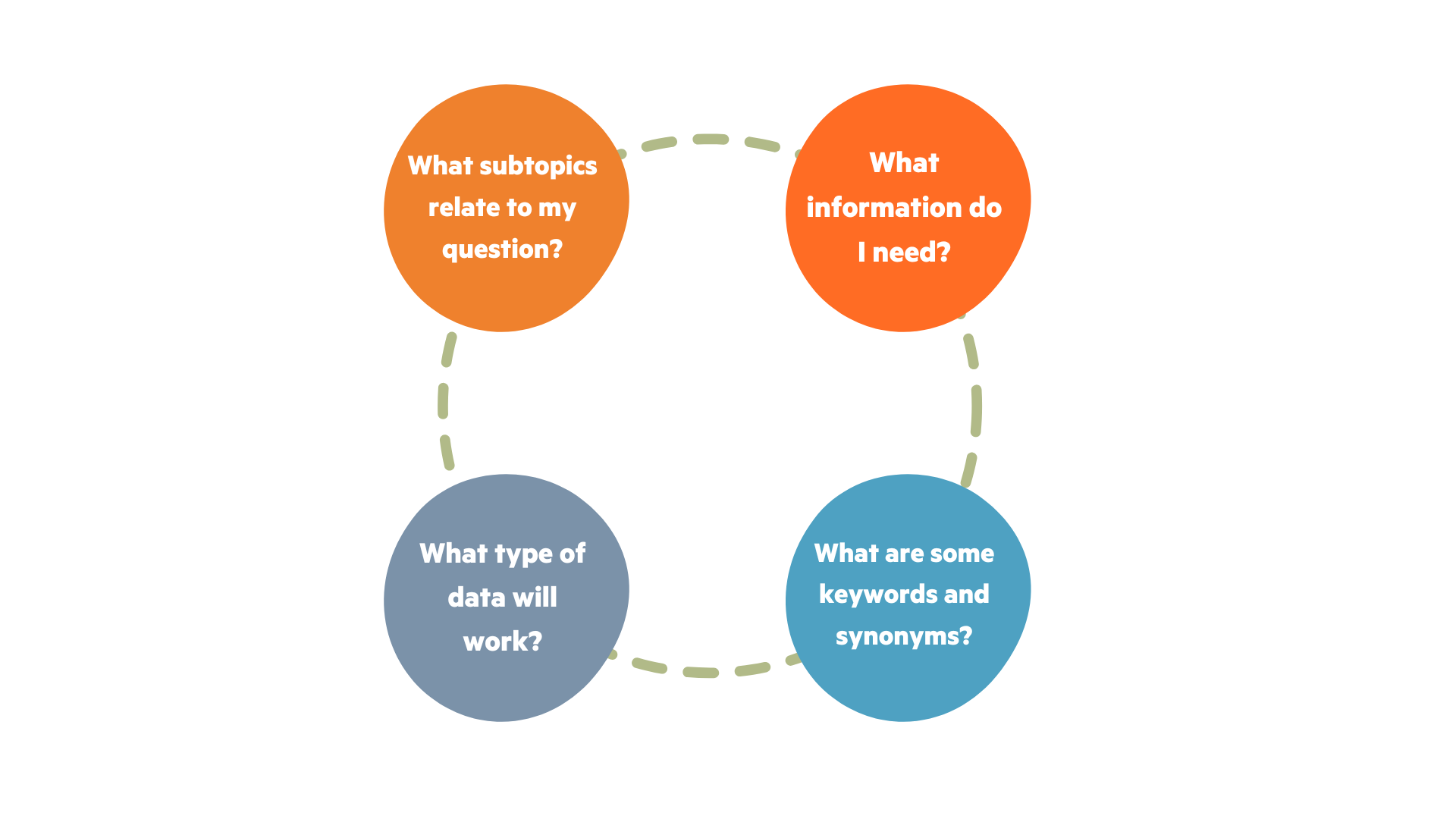

This guide is designed to give you a better understanding of:
 The numbers don't lie! Using and analyzing data can add great value to your work and help support you in making big decisions. This workshop will show you where to find data and datasets and introduce key skills and strategies to use and interpret datasets.
Using data to strengthen your analysis and ideas will tremendously improve the quality of your work. With suitable and authentic data, your findings become more trustworthy, and people can rely on what your work says.
Datasets serve as an effective tool for tracking and analysing important information as well as to support strategic decisions
This is false!
This is also false!
You will need to understand the data itself before you can fully use it in your research. The following are some of the questions you may want to ask yourself about the dataset:
Much like other information, you need to check to see if it is trustworthy and reliable.
Searching for data is different from searching for journal articles or websites.
Dataset searching can take time and requires a lot of patience
Let's pretend that you are looking to buy a home in Victoria, British Columbia. Watch the video below for an example of how to search Google and Statistics Canada to answer this research question:
Downloadable Data
Statistics
All UCW paid databases are found in the Databases A-Z list. You will only have access to these while you are a UCW student.
Not sure how to access library databases? Watch this video:
We evaluate throughout the search process to decide if a source is reliable and useful to our research. When we evaluate we question the data we are using. Where did the data come from? Who created it?
Remember: Not every dataset is ready for you to use, and not every dataset is appropriate or useful for your research. Every time you find a new potential dataset you should evaluate it.
To evaluate your dataset, ask yourself the following:
There is no set standard citation guide for citing data. The citation will change depending on how and where the data is published. Use the following general references as a guideline.
General Reference: Published Data
Author names or name of group. (Year of Publication). Title of Publication (Version Number) [Data set]. Publisher Name OR DOI/URL.
General Reference: Unpublished Data
Author names or name of group. (Year the data was collected). Title of Publication (Version Number) [Data set]. Source of unpublished data OR DOI/URL.
Example Citation
O'Donohue, W.. (2017). Content analysis of undergraduate psychology textbooks (ICPSR 21600; Version V1) [Data set]. ICPSR. https://doi.org/10.3886/ICPSR36966.v1
For more information on citing datasets and statistical data from databases, check out these links:
Citation Tips:
Need more help?
If you would like more guidance on how to find data or how to cite data using APA please reach out to [email protected] and the Library can help support your research further.