
This guide provides an overview of artificial intelligence tools to help students engage with AI in a responsible way.
Tip for students: If you have doubts about using AI in your assignments, check your instructor's policies and reach out to them to clarify anything that is unclear.
Artificial Intelligence (AI) is an umbrella term for technologies which are able to do tasks in ways that resemble human intelligence.
There are many types of AI technologies, and the term is used to mean a broad range of things, which can lead to confusion. We encounter AI in many aspects of our daily lives, from Siri and Grammarly to ChatGPT and QuilBot. This guide aims to help students understand how to responsibly engage with AI technology in an academic context.
Currently Popular AI Tools by Instructional Designer
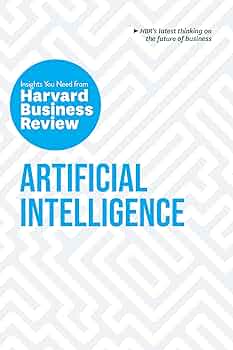
Artificial Intelligence : The Insights You Need From Harvard Business Review by Thomas H. Davenport
Format: eBook
Publication Date: 2019

Artificial Intelligence: Work, Machines, and Human Interaction by Tonya Randolph
Format: eBook
Publication Date: 2021

Augmented Exploitation: Artificial Intelligence, Automation and Work by Phoebe Moore; Jamie Woodcock
Format: eBook
Publication Date: 2021
Power and Prediction: The Disruptive Economics of Artificial Intelligence by Ajay Agrawal; Joshua Gans; Avi Goldfarb
Format: eBook
Publication Date: 2022
Radically Human: How New Technology Is Transforming Business and Shaping Our Future by Paul Daugherty; H. James Wilson
Format: eBook
Publication Date: 2022
Artificial Intelligence technologies are tools like any other. It is important to know each instructor's guidelines and rules surrounding the use of AI and to inform yourself of how to use AI responsibly by maintaining your academic integrity, using critical thinking, and following instructor guidelines and the institutional Generative AI Statement.
AI tools such as ChatGPT should never be a replacement for you doing your own work. ChatGPT is not an acceptable tool to generate a complete assignment submission.
AI can be helpful for understanding concepts and generating ideas, however you must always use your critical thinking skills and evaluate each source used, and you must acknowledge the use of AI in your assignment.
Similarity tools such as Turnitin feature AI detection. The best way to avoid an academic integrity incident is to use your own words and to always cite your sources correctly using APA format.
To better understand how to paraphrase, meet with a writing coach. This will help you improve your writing skills and be able to paraphrase independently, without relying on AI tools.
To maintain and demonstrate your academic integrity:
AI literacy is the ability to understand and work with AI technologies, recognizing AI’s capabilities and limitations. It includes questioning and evaluating AI tools to use them effectively by making better choices of which AI to use.
Use the ROBOT method to evaluate AI tools:
Adapted from: Hervieux, S. & Wheatley, A. (2020). The ROBOT test [Evaluation tool]. The LibrAIry. https://thelibrairy.wordpress.com/2020/03/11/the-robot-test
AI literacy is the ability to understand and work with AI technologies and recognize AI’s capabilities and limitations. It includes questioning and evaluating AI tools to use them effectively by making better choices of which AI to use.
Use the SIFT method to evaluate AI output:
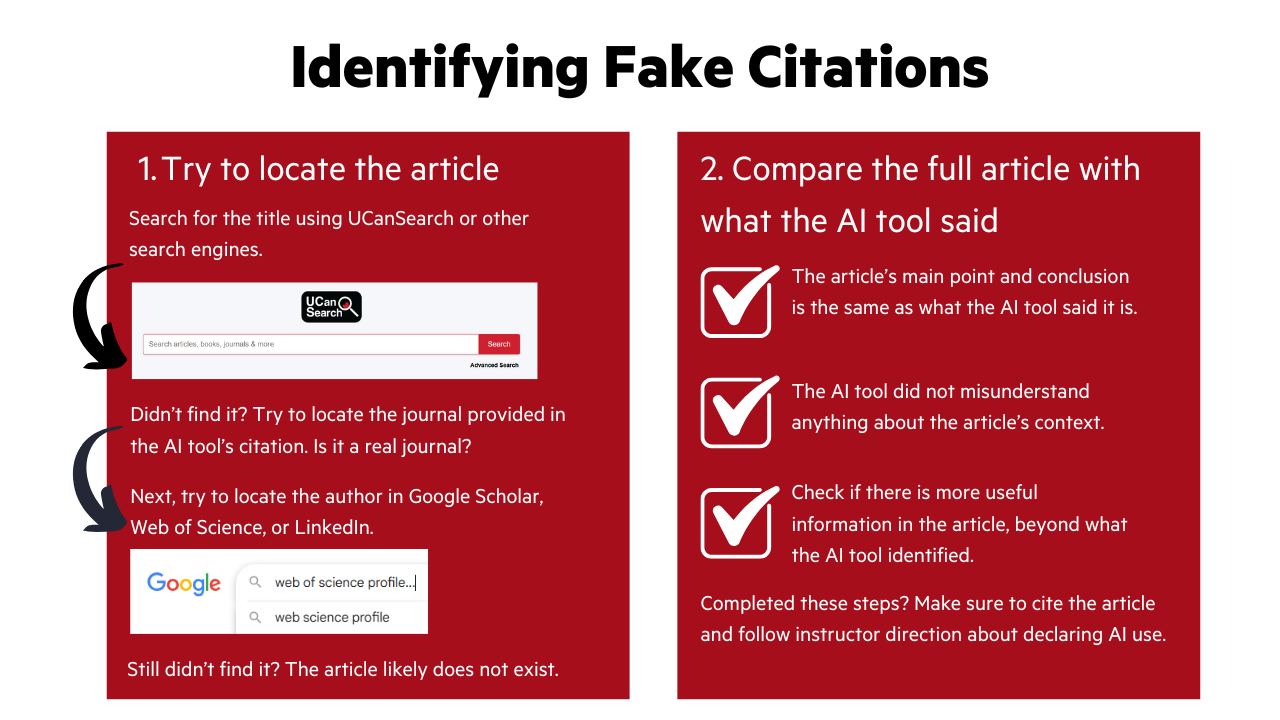
Sometimes AI tools generate fake citations. These citations will look real, but contain fake titles, authors, and journal names. Follow these guidelines to help identify if AI is citing a real source. Note that AI technology is rapidly changing, so it may not be possible to be completely sure if a citation is real.
Compare sources: Find other reliable sources that support the AI's claims. Look for different sources on the topic or try to find where the AI got its information
Verify citations: You can ask the AI for references, but be cautious as they could be fake. Search for the citations in the library or the web to make sure they're real
Confirm source articles: Ensure that the articles cited by the AI have the information it provided and are not made up
Check for recent information: Verify if the information is up-to-date, especially for news and research. AI may have outdated information, like ChatGPT (GPT-3.5), which uses 2021 data and cannot access current internet data
When working with information by and about Indigenous peoples, some unique ethical considerations apply. This section outlines what we need to know about Indigenous information and AI.
Information in this section is adapted from the University of Saskatchewan Generative Artificial Intelligence Research Guide and the sources cited within.
Data sovereignty refers to Indigenous people's right to control how their data is used. Indigenous data includes:
AI can interfere with the right to data sovereignty. When we input data into an AI tool, we do not know where it is going or how it will be used. The data could be entered into a larger database or shared with another user of the AI tool.
Before inputting information related to Indigenous people into an AI tool, we should consider these questions:
AI tools are created by humans and trained using human-made information. That means human biases like racism and colonialism are built into AI tools. If we use AI to search for information about Indigenous people, we must know that the AI tool might provide biased information.
To learn more about bias in AI, we recommend reading Algorithms of Oppression : How Search Engines Reinforce Racism, by Safiya Umoja Noble [Available from UCW Library as an eBook]
Cultural distortion occurs when AI collects large amounts of data about Indigenous languages or cultural practices. When this data collection happens, Indigenous languages and cultural practices can be distorted and misrepresented by bias and misinformation (Chandran, 2023).
Examples of cultural distortion:
How to prevent cultural distortion:
AI tools that generate visual artwork can appropriate and harm Indigenous artists and communities. This appropriation happens when AI generates art that mimics traditional and modern Indigenous art styles.
Why is this harmful?
Permitted use: Be sure you have permission from your instructor before using Generative AI tools in your research and writing process. Follow their requirements outlined in the course syllabus.
Evaluation: Be sure you evaluate the Generative AI tool and its output before using it in your research and assignment. See the Evaluating AI section of the Artificial Intelligence Guide for more details.
Best practices:
Reference List Format:
AI Company Name. (year, month day). Title of chat in italics [Description, such as Generative AI chat]. Tool Name/Model. URL of the chat
Example:
OpenAI. (2025, August 21). High school grammar concepts [Generative AI chat]. ChatGPT. https://chatgpt.com/share/68a77b60-0ee4-800c-9acc-cd3fd573c311
Example In-Text: (Open AI, 2025)
Note: Do not include page or section numbers for direct quotation, as there is no permanent record of the generated text.
Reference List Format:
AI Company Name. (year). Tool Name/Model in Italics and Title Case [Description; e.g., Large language model]. URL of the tool
Example:
Anthropic. (2025). Claude 4 Sonnet [Large language model]. https://claude.ai/new
Example In-Text: (Anthropic, 2025)
Note: Include citations for the general use of an AI tool when it would be unhelpful, unethical, or otherwise inappropriate to cite a specific chat, or when you want to point to the existence of the AI tool but not necessarily cite specific information from it (i.e. when it is used to refine your writing, translate small sections, generate code, images, or other visual information, or used as part of the overall methodology of your work).
AI generated images are cited like all other figures, such as photographs, graphs, charts, etc. Figures require a figure number, title, and a figure note in the body of your work, along with a citation in the reference list. It is good practice to also include a transcript of the AI conversation in an appendix. This guidance is based on existing best practices, please confirm this citation format with your instructor.
Reference List Format:
AI Company Name. (year, month day). Title of image prompt in italics [Description; e.g. Generative AI chat]. Tool Name/Model. URL of the chat
Example:
OpenAI. (2026, March 16). Working in the library [Generative AI chat]. ChatGPT. https://chatgpt.com/share/69b851d8-de0c-8012-b7b5-112114748a3b
Figure Note Format
Note. Description and "prompt", by AI Company Name, Tool Name/Model, year (URL).
Example:
Note. Image generated using the prompt "Create an image of a person working on a computer in a library", by OpenAI, ChatGPT, 2026 (https://chatgpt.com/share/69b851d8-de0c-8012-b7b5-112114748a3b)

Reference List Format:
AI Company Name. (year). Title of image prompt in italics [Description; e.g. Generative AI chat]. Tool Name/Model. URL of the tool
Example:
Microsoft. (2026). Microsoft Copilot [Large Language Model]. Retrieved March 16, 2026, from https://copilot.microsoft.com/
Figure Note Format
Note. Description and "prompt", by AI Company Name, Tool Name/Model, Retrieval date (URL).
Example:
Note. Image generated using the prompt "Create an image of a person working on a computer in a library", by Microsoft, Microsoft Copilot, Retrieved March 16, 2026 (https://copilot.microsoft.com/)

Some of this guidance may be updated as recommendations evolve.
For more information on citing AI tools, see the APA Style blog post on How to Cite ChatGPT and Citing generative AI in APA Style: Part 1—Reference formats.